




Rheostat Manufacturers in India
In the vast landscape of electrical and electronic engineering, few components are as fundamental — and yet as frequently overlooked — as the rheostat. A variable resistor by design, a rheostat controls current flow within a circuit by adjusting resistance, making it indispensable in everything from industrial motor speed controllers to laboratory training setups. As India’s manufacturing sector continues its upward trajectory, the demand for precision-grade rheostats has grown significantly — and so has the number of Rheostat Manufacturers in India offering solutions for diverse technical requirements.
This guide explores what rheostats are, their types and applications, what to look for when sourcing them, and why partnering with reputable Indian manufacturers is a smart decision for industries and institutions alike.
What Is a Rheostat and How Does It Work?
A rheostat is a two-terminal variable resistor that is used to control electrical resistance in a circuit without interrupting the current flow. Unlike a potentiometer, which uses three terminals and is primarily used for voltage division, a rheostat is designed to handle higher current loads, making it suitable for power circuits.
The working principle is simple: as the sliding contact (wiper) moves along the resistive element, it changes the length of the conductor through which current passes. A longer path equals higher resistance; a shorter path equals lower resistance. This adjustable resistance allows operators to precisely regulate current, voltage, and power output across a wide range of equipment.
Rheostats are typically wound from resistance wire — such as nichrome, manganin, or similar alloys — around a ceramic, porcelain, or fibre core. The choice of winding material and core directly affects the performance, accuracy, and thermal tolerance of the device.
Types of Rheostats Available from Indian Manufacturers
Rheostat manufacturers in India produce several variants to suit specific applications and operating environments:
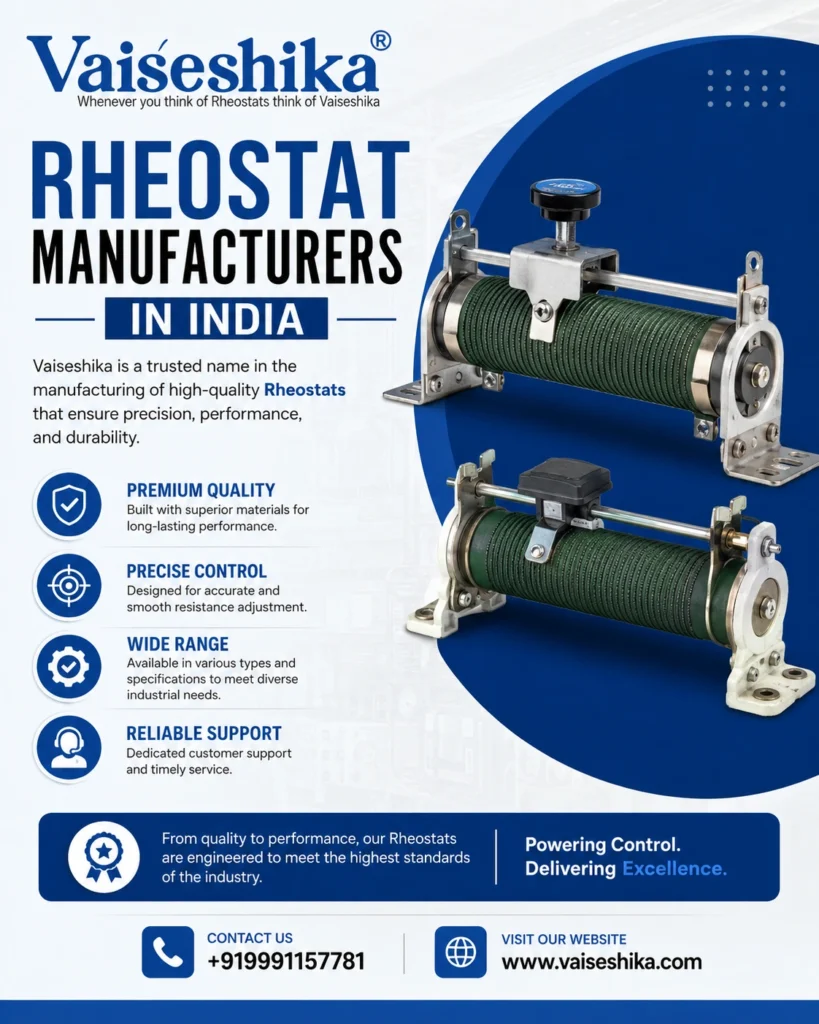
Wire-Wound Rheostats: The most common type, these use a resistance wire coiled around an insulating core. They offer excellent precision, stability, and durability, making them ideal for laboratory use, motor control applications, and calibration instruments. Wire-wound rheostats can handle high power dissipation and are available in a wide range of resistance values.
Rotary Rheostats: These feature a circular resistive element with a rotating contact. They are widely used in educational laboratory setups, testing panels, and control boards where smooth, continuous resistance adjustment is required.
Slide Rheostats: Also known as linear or slider rheostats, these use a sliding contact that moves along a straight resistive element. They are commonly found in physics labs and training institutions to demonstrate Ohm’s Law and related electrical principles.
Carbon Film Rheostats: Used in low-power applications, these offer smaller sizes and are primarily found in electronic devices and control panels.
Motorised Rheostats: These incorporate a small motor mechanism to automate resistance adjustment, making them suitable for industrial automation, servo systems, and remote-controlled power regulation.
Key Applications of Rheostats Across Industries
The versatility of rheostats has made them a staple component across multiple sectors. Here is a look at where rheostat manufacturers in India are most commonly supplying:
Educational Institutions: Physics and electrical engineering laboratories across schools, colleges, and universities use slide and rotary rheostats to conduct experiments on resistance, current, and voltage. They are essential components of practical physics kits and lab demonstration setups.
Industrial Motor Control: Manufacturing plants use high-wattage rheostats to control the speed of DC motors and other driven equipment. By adjusting the field resistance or armature resistance, operators can regulate motor speed with precision.
Power Generation and Distribution: Rheostats are used in generator excitation circuits to regulate output voltage. They also find application in voltage regulators, transformer tap changers, and load balancing systems.
Lighting Control Systems: In theatre lighting, photography studios, and architectural lighting setups, rheostats serve as dimmer controls, allowing smooth and gradual adjustment of light intensity.
Testing and Calibration Laboratories: Precision wire-wound rheostats are widely used in calibration labs as resistance references and current-limiting devices for testing electrical instruments such as ammeters, voltmeters, and multimeters.
Electroplating and Chemical Processing: Industries that rely on controlled DC current for electrochemical processes use heavy-duty rheostats to maintain precise current levels during plating operations.
Research and Development: R&D laboratories in electronics, materials science, and physics use rheostats as variable resistance elements in experimental circuits, prototype testing, and component characterisation.
What to Look for When Choosing a Rheostat Manufacturer in India
With numerous rheostat manufacturers in India serving the market, it is important to evaluate potential suppliers on a few critical parameters:
Resistance Range and Tolerance: Confirm the available resistance range (in ohms) and the tolerance level (how close the actual value is to the specified value). Precision applications demand tight tolerances of ±1% or better.
Power Handling Capacity (Wattage Rating): Every rheostat has a maximum power dissipation rating. Choosing an under-rated rheostat for a high-current application leads to overheating and premature failure. Always select a device rated well above the expected operating load.
Winding Material and Resistance Wire Quality: Nichrome and manganin wire offer excellent stability and low temperature coefficients. Confirm the alloy composition with your manufacturer to ensure long-term performance consistency.
Build Quality and Core Material: A ceramic or steatite core provides superior thermal insulation and mechanical strength, making it essential for high-power applications. Avoid units with plastic cores in power-circuit environments.
Certifications and Compliance: Reputable rheostat manufacturers in India will supply products that comply with IS (Indian Standards), IEC standards, and, where relevant, ISO quality management requirements. Ask for test certificates and calibration data.
Customization Capability: Different applications require different form factors, shaft lengths, terminal configurations, and enclosure types. A manufacturer with in-house customization capacity can tailor the rheostat to your exact design specifications.
After-Sales Support and Spare Parts Availability: The best manufacturers offer technical guidance during selection, reliable delivery timelines, and availability of spare parts or replacement units to minimize downtime.
Why India Is a Growing Hub for Rheostat Manufacturing
India’s scientific instruments and electrical components manufacturing sector has matured considerably over the past five decades. Several factors make the country an increasingly attractive source for precision rheostats:
A deep pool of engineering talent, competitive production costs, expanding ISO-certified manufacturing facilities, and growing domestic demand from sectors like defence, space research, railways, and heavy industry have collectively pushed Indian manufacturers to raise their quality standards to global levels.
Government initiatives supporting domestic manufacturing — including Make in India and the PLI (Production Linked Incentive) scheme for electronics and electrical components — have further accelerated investment in precision instrument production. Today, several rheostat manufacturers in India export their products to research institutions and industrial clients across Asia, Europe, the Middle East, and Africa, competing confidently with international brands on both quality and cost.
How to Identify a Reliable Rheostat Supplier
Beyond the product specifications, here are practical steps to verify the credibility of any rheostat manufacturer in India before placing an order:
Request product data sheets and test reports for the specific model you need. Ask for references from existing clients in your industry sector. Visit the manufacturing facility if possible, or request a virtual tour to assess their production environment, testing infrastructure, and quality control processes. Check whether the manufacturer has a NABL-accredited or ISO 17025-certified calibration facility, as this indicates a higher standard of metrology and measurement integrity.
Trust Vaiseshika for Precision Resistance Instruments
When it comes to precision resistance-based instruments manufactured to the highest quality standards in India, Vaiseshika Electron Devices stands in a league of its own. Founded in 1976 and headquartered in Ambala — India’s celebrated hub for scientific instrument manufacturing — Vaiseshika has spent over five decades engineering world-class resistance standards, decade resistance boxes, precision standard resistors, and a comprehensive range of educational and laboratory instruments trusted by ISRO, DRDO, NTPC, Maruti Suzuki, Siemens, Reliance, Bosch, and hundreds of research institutions across the globe. With ISO 9001 and ISO 17025:2017 accredited processes, a NABL-recognized calibration laboratory, national awards for quality from the Government of India, and an assurance of 10–15 years of product maintainability, Vaiseshika is the manufacturer of choice for engineers and researchers who demand uncompromising precision. Whether you are looking for rheostats, precision resistance standards, or a complete suite of calibration and optical instruments, Vaiseshika delivers Made-in-India quality built to global benchmarks. Visit www.vaiseshika.com to explore the full product range or contact their expert team for a customised solution.
Frequently Asked Questions (FAQs)
Q1. What is the difference between a rheostat and a potentiometer?
While both are variable resistors, the key difference lies in their terminal configuration and application. A rheostat uses two terminals — one fixed and one sliding — and is designed to control current in high-power circuits by varying resistance. A potentiometer, on the other hand, uses three terminals and is primarily used for voltage division or signal-level adjustment in low-power electronic circuits. In practical terms, rheostats handle significantly higher wattages and are used in power and motor control environments, whereas potentiometers are found in audio equipment, sensors, and control panels. Reputable rheostat manufacturers in India typically offer both types to serve the full spectrum of electrical and electronic applications.
Q2. What materials are used in the winding of precision rheostats?
The resistive winding in a precision rheostat is most commonly made from nichrome (an alloy of nickel and chromium) or manganin (an alloy of copper, manganese, and nickel). Nichrome is preferred for general-purpose and industrial applications due to its high resistivity and excellent oxidation resistance at elevated temperatures. Manganin is favoured in precision laboratory and calibration-grade rheostats because of its extremely low temperature coefficient of resistance, which ensures that the resistance value remains highly stable even when the device heats up during use. Top rheostat manufacturers in India use certified resistance wire with traceable alloy composition to guarantee performance consistency across production batches.
Q3. How do I select the right wattage rating for a rheostat?
Selecting the correct wattage rating is one of the most critical steps in rheostat specification. The power dissipated by a rheostat in a circuit is calculated using the formula P = I² × R, where P is power in watts, I is the current in amperes, and R is the resistance in ohms. As a best practice, always choose a rheostat with a power rating at least 25–30% higher than the maximum calculated dissipation in your circuit. This safety margin accounts for transient overloads, ambient temperature variations, and long-term performance degradation. When in doubt, consult the technical team at your chosen rheostat manufacturer in India for application-specific recommendations.
Q4. Can rheostats be customised for specific industrial or laboratory requirements?
Yes, absolutely. Most established rheostat manufacturers in India offer customisation across a range of parameters including resistance value, wattage rating, winding wire alloy, core material (ceramic, steatite, or fibre), shaft length, terminal style, mounting configuration, and enclosure type. Custom rheostats are particularly in demand from defence laboratories, space research institutions, railway signalling departments, and power utilities that require non-standard specifications not available in off-the-shelf catalogues. When requesting a custom rheostat, provide the manufacturer with your full circuit parameters — supply voltage, maximum operating current, duty cycle, ambient temperature range, and physical installation constraints — to ensure an accurate design and quotation.
Q5. How should rheostats be maintained to ensure long service life?
Proper maintenance significantly extends the operational life of a rheostat and preserves its accuracy over time. Key maintenance practices include periodically cleaning the resistive element and sliding contact with a dry, lint-free cloth to remove dust and oxidation; inspecting the wiper contact for signs of wear or pitting and replacing it when necessary; ensuring that the rheostat is never subjected to current loads exceeding its rated wattage; checking terminal connections for tightness and signs of corrosion at regular intervals; and storing unused rheostats in a dry, temperature-controlled environment away from humidity and chemical vapours. For precision laboratory-grade rheostats used in calibration applications, periodic re-verification of resistance values against a traceable reference standard is also recommended. Many leading Rheostat Manufacturers in India offer after-sales calibration and maintenance services to keep their instruments performing at peak accuracy throughout their service life.
Most Searched Keywords
- Rheostat Manufacturers in India
- Top Rheostat Manufacturers in India
- Best Rheostat Manufacturers in India
- Rheostat Manufacturers
- Rheostat Manufacturers India