




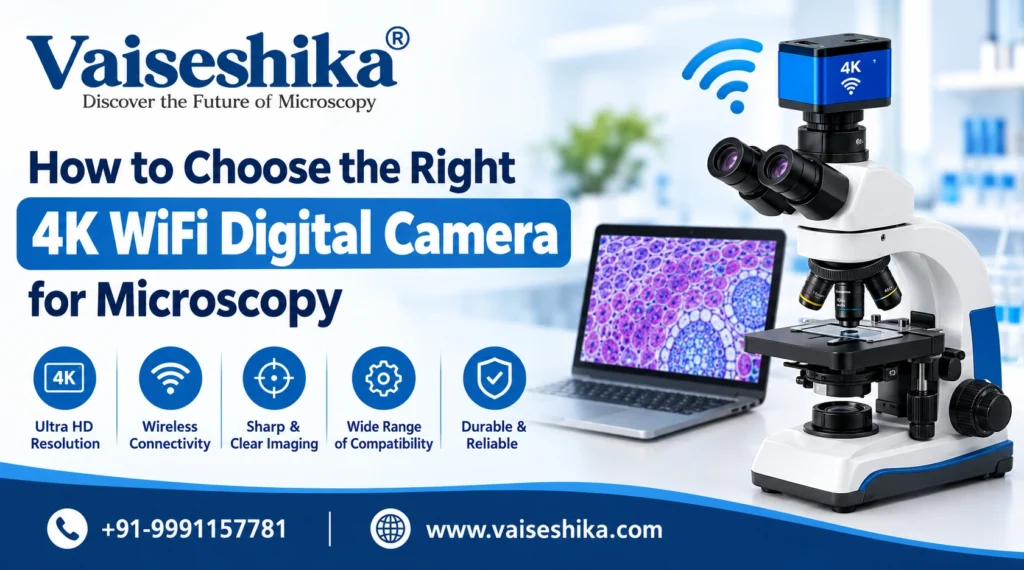
Imagine looking at a blood sample, a plant cell, or a tiny circuit board and being able to share that exact view instantly with your students, colleagues, or clients on any screen in the room. That’s the real power of a 4K WiFi digital camera for microscopy. It’s no longer just a tool for research labs — it has become an essential accessory for schools, hospitals, quality control units, and even hobbyists across India who want clearer, shareable, and more accurate microscopic imaging.
In this guide, we’ll break down what makes these cameras so useful, how they work, and what to look for before buying one.
What Is a 4K WiFi Digital Camera for Microscopy?
A 4K WiFi digital camera for microscopy is a specialized imaging device that attaches to a microscope in place of, or alongside, the standard eyepiece. It captures ultra-high-resolution images and videos (4K resolution, meaning around 8 million pixels) and transmits them wirelessly to smartphones, tablets, laptops, or smart TVs using built-in WiFi connectivity.
Instead of squinting through a single eyepiece, multiple people can view the same magnified image at the same time on a bigger screen. This makes microscopy far more collaborative, efficient, and practical for both teaching and diagnostic purposes.
Why 4K Resolution Matters
Traditional microscope cameras often max out at 1080p or lower, which can blur fine details when you zoom in. A 4K sensor captures:
- Sharper cell structures and tissue patterns
- Clearer edges on microorganisms and particles
- Better color accuracy for diagnostic interpretation
- High-quality images suitable for research papers and reports
For fields like pathology, embryology, and materials science, this level of clarity can make a genuine difference in accuracy.
Key Benefits of Using a WiFi-Enabled Microscopy Camera
1. Wireless Convenience
No more tangled USB cables running from the microscope to a computer. WiFi connectivity lets you view live footage on any connected device within range, which is especially useful in busy labs or classrooms with limited desk space.
2. Real-Time Collaboration
Multiple viewers can watch the same feed simultaneously. This is a huge advantage for:
- Medical training sessions
- Group lab work in colleges
- Remote consultations between doctors
- Live demonstrations in science exhibitions
3. Easy Image and Video Capture
Most 4K WiFi microscopy cameras come with companion apps that allow you to capture stills, record videos, and even annotate images directly on your device. This is helpful for documentation, presentations, and academic reports.
4. Better Accuracy in Diagnostics
In medical and veterinary labs, sharper imaging supports more confident identification of cells, parasites, or abnormalities, reducing the chances of misinterpretation.
5. Ideal for Remote Learning
With India’s growing focus on digital education, especially in science and biology streams, these cameras allow teachers to demonstrate live microscopic views to an entire classroom or even students learning remotely.
Who Should Use a 4K WiFi Microscopy Camera?
This technology isn’t limited to research scientists. It’s widely useful for:
- Schools and colleges – for biology, chemistry, and physics practicals
- Hospitals and diagnostic centers – for pathology and hematology work
- Agricultural and food testing labs – for inspecting samples and quality checks
- Jewelry and gemology businesses – for examining stone clarity and craftsmanship
- Electronics manufacturers – for inspecting PCB soldering and micro-components
- Hobbyists and researchers – for personal exploration of nature, insects, or minerals
How to Choose the Right 4K WiFi Digital Camera for Microscopy
Before buying, consider these important factors:
1. Resolution and Sensor Quality
Look for a true 4K sensor (not just “4K output” through upscaling) for genuine image sharpness.
2. Compatibility with Your Microscope
Check the eyepiece diameter (commonly 23.2mm or 30mm) and confirm the camera adapter fits your existing microscope model.
3. WiFi Range and Stability
A stable wireless connection is essential, especially in labs with multiple devices connected to the same network.
4. App Features
Good companion apps should support:
- Live streaming
- Image capture in high resolution
- Video recording
- Measurement and annotation tools
- Easy export/sharing options
5. Battery Life and Build Quality
For portable use, check battery backup time. For lab environments, prioritize durable, heat-resistant builds.
6. Software and OS Compatibility
Ensure the app works smoothly with both Android and iOS, along with Windows or Mac if you plan to use larger screens.
Common Applications in Everyday Use
- Cell and tissue examination in medical labs
- Water and soil sample testing in environmental studies
- Insect and plant analysis in agricultural research
- Fabric and textile fiber inspection in manufacturing
- Metallurgical analysis for surface defects
- Skin and hair diagnostics in dermatology clinics
Tips for Getting the Best Results
- Keep the microscope’s lighting consistent for accurate color representation.
- Clean the lens and eyepiece adapter regularly to avoid dust interference.
- Use a stable WiFi network to prevent lag during live viewing.
- Update the companion app regularly for better performance and bug fixes.
- Calibrate the camera settings (brightness, contrast, white balance) based on your sample type.
Final Thoughts
A 4K WiFi digital camera for microscopy bridges the gap between traditional microscopy and modern digital convenience. Whether you’re a teacher explaining cell structures to a classroom, a lab technician documenting diagnostic samples, or a hobbyist exploring the micro-world, this technology brings clarity, accessibility, and collaboration to your work.
As more institutions and professionals across India move toward digital-first lab setups, investing in a reliable 4K WiFi microscopy camera is a smart, future-ready decision that improves both accuracy and efficiency.
Frequently Asked Questions (FAQs)
Q.1 What is the main advantage of a 4K WiFi digital camera for microscopy over a regular microscope camera?
The biggest advantage is image clarity combined with wireless sharing. A 4K sensor captures much finer detail than standard HD cameras, and WiFi connectivity lets multiple people view the same feed without cables.
Q.2 Can a 4K WiFi microscopy camera be used with any microscope?
Most cameras are compatible with standard eyepiece sizes like 23.2mm or 30mm, but it’s important to check adapter compatibility before purchasing to ensure a proper fit.
Q.3 Is a WiFi microscopy camera suitable for classroom teaching?
Yes, it’s an excellent tool for education. Teachers can display live microscopic images on a projector or shared screen, helping the entire class see the same sample clearly.
Q.4 Do these cameras work without an internet connection?
Yes, most models create their own local WiFi hotspot, so they can connect directly to your phone or laptop without requiring external internet access.
Q.5 What should I check before buying a 4K WiFi digital camera for microscopy?
Focus on sensor quality, microscope compatibility, WiFi stability, app features, and build durability. These factors directly affect image quality and ease of use in daily operations.