



In the quickly developing industrial and technological world, electrical measurement is no longer a matter of choice but a necessity. Digital Resistance Calibration System in India is considered one of the most important parameters in electrical testing and instrumentation. In the case of research laboratories, power utilities, and manufacturing plants, measurement of resistance with precision forms the basis of safety, quality, and regulation. It is here that the Digital Resistance Calibration System in India comes in very handy, which makes the measuring tools of resistance provide credible and repeatable measurements.
Calibration Systems Digital resistors Understand digital resistor systems
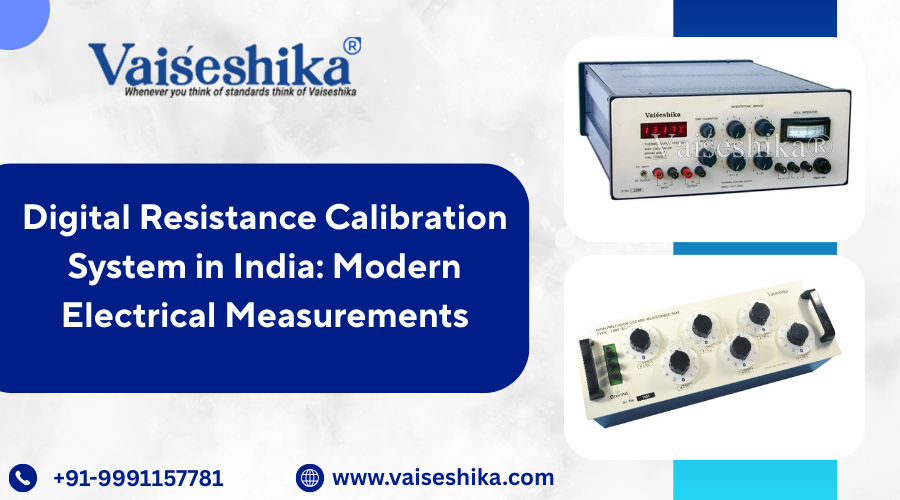
A Digital Resistance Calibration System is an advanced system that calibrates a resistance-measuring instrument like a multimeter, ohm meter, resistance bridge and process instrument. Digital systems have advanced electronics, automated control and high-stability reference resistors to achieve accurate and repeatable calibration, unlike traditional manual methods.
These systems can produce or measure resistance values with a wide range, between micro-ohms needed in contact resistance testing and giga-ohms needed in insulation and high-voltage use. The web interface enables better resolution, fewer human error and harmonious data recording.
Increased demand of Digital Resistance Calibration System in India
Cases of electronic manufacturing, renewable energy, railways, defence, telecommunications and aerospace sectors have greatly grown in India, leading to a surge in the demand for a reliable Digital Resistance Calibration System. With the increased emphasis on the concept of Make in India and export-based manufacturing, compliance with national and international standards of quality has become compulsory as well.
Calibration systems that are accredited and meet the requirements of the ISO/IEC 17025 are required by accredited calibration laboratories, testing centres, and industrial quality departments. To achieve these requirements, the use of a digital resistance calibration system can ensure traceability to both national and international standards and confidence in the measurement results.
Key Features and Advantages
Digital resistance calibration systems produced today have several benefits compared to traditional methods:
High Accuracy and Stability
These systems have precision reference resistors and temperature-compensated circuits, which act as a guarantee to a long term stability and low uncertainty.
Wide Measurement Range
One system can span several decades of resistance, eliminating the use of multiple instruments.
Automation and Efficiency
Automated calibration routines minimize human intervention and save time, as well as decrease operator bias errors.
Data Logging and Reporting
Digital systems are able to store calibration data, create reports and connect with laboratory information management systems (LIMS).
Compliance with Standards
They make it easier to comply with national and international standards that are essential to audits and certifications.
Industries of Digital Resistance Use
In India, the Digital Resistance Calibration System is very popular in the following spheres:
Calibration Laboratories: To offer traceable calibration services to the industries and institutions.
Electronics Production: This is about quality control of materials and the completed goods.
Power and Energy Sector: Calibration of measuring equipment applied in substations, power plants, and renewable energy systems.
Railway and Defiance: Promoting the safety and high-level technical norms.
Research and Development: Providing the possibility of proper experimentation and validation of new technologies.
Significance of Selecting the Appropriate System
The choice of the appropriate digital resistance calibration system can be made based on accuracy specifications, level of uncertainty, range coverage, automation, and after-sales service. Environmental stability, ease of use, and the availability of services are also considered important in India, known to have a diverse operating environment.
The organizations should also have in mind the future scalability, that is, the system should be able to accommodate the changing calibration requirements as well as increasing accuracy needs.
To sum up, the Digital Resistance Calibration System in India is a foundation of the correct electrical measurement, and it assists the quality, safety, and compliance in various sectors. As more and more attention is paid to accuracy and traceability, the need to invest in the development of high-quality calibration solutions as a strategic requirement increases. Such companies as Vaiseshika are involved in this ecosystem by providing the expertise and solutions to meet the increasing calibration and metrology demand in India.