




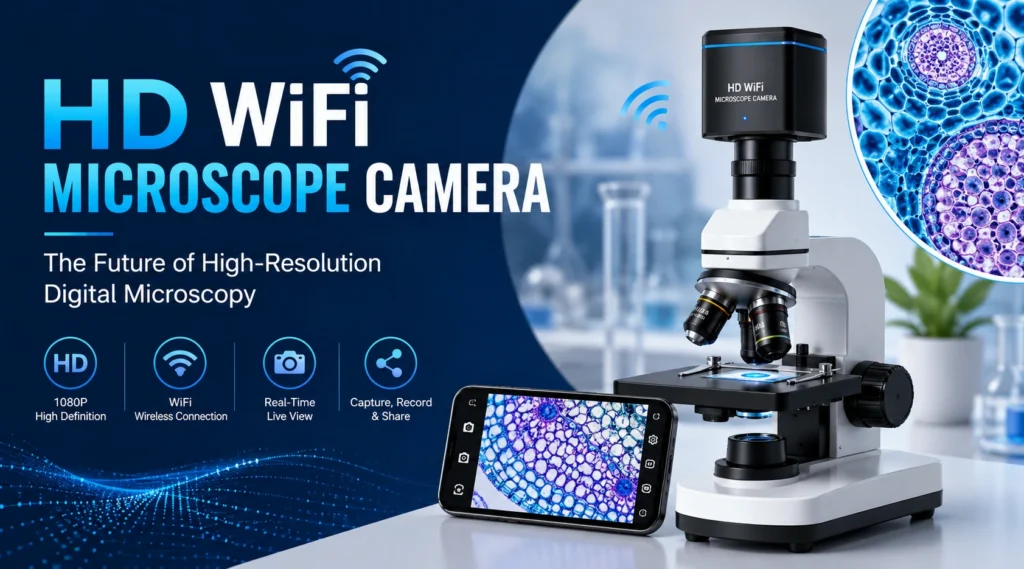
In today’s fast-evolving world of scientific research, quality control, and education, the demand for advanced imaging solutions has never been higher. Among the most transformative innovations in optical instrumentation is the HD WiFi Microscope Camera — a device that combines the precision of professional microscopy with the convenience of wireless digital connectivity. Whether you are a researcher, laboratory technician, engineer, or educator, understanding how an HD WiFi Microscope Camera works and what it offers can help you make a well-informed investment that elevates the quality of your work.
What Is an HD WiFi Microscope Camera?
An HD WiFi Microscope Camera is a digital imaging device specifically designed to attach to or integrate with a microscope and transmit high-definition visual data wirelessly over a WiFi network. Unlike traditional eyepiece-based microscopy, which requires the observer to be physically positioned at the microscope, an HD WiFi Digital Camera for Microscopy allows live images and video to be streamed directly to smartphones, tablets, laptops, or large display monitors in real time.
This wireless capability transforms a conventional microscope into a collaborative, multi-user observation tool. Teams in different parts of a laboratory — or even in different locations entirely — can simultaneously view the same specimen without any degradation in image quality.
The Rise of 4K WiFi Microscope Camera Technology
While HD resolution (typically 1080p) was considered cutting-edge just a few years ago, the industry has rapidly advanced toward ultra-high definition. The 4K WiFi Microscope Camera represents the next generation of microscopy imaging, offering four times the pixel density of standard HD cameras.
A 4K WiFi Digital Camera for Microscopy captures specimens in extraordinary detail, revealing cellular structures, surface textures, micro-cracks in materials, and other fine features that lower-resolution cameras simply cannot resolve. For applications in metallurgy, pathology, semiconductor inspection, PCB analysis, gemology, and biological research, the difference between HD and 4K imaging can be the difference between a missed finding and a critical discovery.
Key advantages of 4K WiFi Microscope Cameras include:
- Ultra-sharp image detail — Every pixel is rendered with precision, making even the smallest specimen features visible.
- Large screen compatibility — 4K output is ideal for projection onto large monitors in training rooms or conference spaces.
- Future-proof investment — As display technology advances, 4K cameras remain compatible with next-generation screens.
- Improved measurement accuracy — More pixels per unit area means more precise dimensional measurements within microscopy software.
Core Features of a High-Quality HD WiFi Digital Camera for Microscopy
When evaluating an HD WiFi Digital Camera for Microscopy, several technical parameters define the quality and usability of the device. Here is what to look for:
- Sensor Quality
The image sensor is the heart of any camera. CMOS sensors with large pixel sizes and backside-illuminated (BSI) architecture perform exceptionally well even in low-light microscopy conditions, producing clean, noise-free images. - WiFi Connectivity Standard
Look for cameras that support dual-band WiFi (2.4 GHz and 5 GHz). The 5 GHz band offers faster data transfer with lower interference, which is essential when streaming 4K video in real time. - Frame Rate
A smooth, lag-free live view requires a minimum of 30 frames per second (fps). High-end models offer 60 fps even at 4K resolution, making them ideal for documenting dynamic biological processes or rapid industrial inspections. - Compatibility
A professional-grade HD WiFi Microscope Camera must be compatible with the C-mount, T2-mount, or trinocular port of your existing microscope. Universal adapters provide flexibility across different microscope models. - Software and App Support
Modern WiFi microscopy cameras come with dedicated iOS and Android applications, as well as Windows and macOS software for image annotation, measurement, and archiving. Cloud integration is an added benefit for remote collaboration. - Storage and Export Options
In addition to live streaming, the best cameras offer onboard SD card storage and direct export capabilities in TIFF, JPEG, and RAW formats — essential for scientific documentation and publication-ready imagery.
Applications of HD and 4K WiFi Microscope Cameras Across Industries
The versatility of an HD WiFi Microscope Camera makes it valuable across a wide spectrum of industries and disciplines:
Scientific Research and Academia
Universities and research institutions use WiFi microscopy cameras to facilitate group learning, remote demonstrations, and collaborative analysis. A 4K WiFi Digital Camera for Microscopy allows live specimen observation to be projected during lectures, eliminating the bottleneck of single-eyepiece access.
Metallurgical and Material Testing
In metallurgical laboratories, capturing grain structure, porosity, or surface defects requires the highest image fidelity. A 4K WiFi Microscope Camera connected to an inverted or upright metallurgical microscope provides the resolution needed to meet international standards for materials analysis.
PCB and Electronics Inspection
Electronics manufacturers rely on HD WiFi Digital Cameras for Microscopy to inspect solder joints, trace defects, and verify component placement during production and quality assurance. Wireless connectivity enables technicians to share findings with engineers instantly.
Biological and Medical Laboratories
Clinical laboratories benefit from WiFi-enabled microscopy cameras for histopathology, hematology, and microbiology. Images can be shared with pathologists for remote consultation, accelerating diagnosis without compromising quality.
Gemology and Jewelry
In the gemology sector, an HD WiFi Microscope Camera allows dealers and appraisers to display fine gemstone inclusions and cuts to clients on large screens, enhancing transparency and trust.
Education and Training
Training environments in medical schools, engineering colleges, and technical institutes use WiFi microscopy cameras to bring the microscopic world to life on classroom displays, fostering interactive, engaging learning experiences.
HD vs. 4K: Which WiFi Microscopy Camera Is Right for You?
Choosing between an HD WiFi Microscope Camera and a 4K WiFi Microscope Camera depends on your specific application and budget.
If your work involves routine inspection, general education, or standard quality checks, a high-quality 1080p HD WiFi Digital Camera for Microscopy delivers excellent performance at a practical price point. The images are crisp, the frame rates are smooth, and the wireless connectivity is seamless.
However, if you are engaged in advanced research, precision measurement, or applications where fine detail is mission-critical, investing in a 4K WiFi Digital Camera for Microscopy is strongly advisable. The dramatically increased resolution pays dividends in accuracy, documentation quality, and professional credibility.
For laboratories anticipating growth or expanding their research scope, a 4K system is the smarter long-term investment — ensuring the imaging system does not become a bottleneck as demands evolve.
Installation and Setup Tips for WiFi Microscopy Cameras
Getting the most out of your HD or 4K WiFi Microscope Camera involves a few best practices:
- Stable WiFi Network: Use a dedicated, password-protected WiFi network for your camera to avoid bandwidth competition with other devices.
- Proper Mounting: Ensure the camera is correctly seated in the C-mount or trinocular port and is free from mechanical vibration that could blur images.
- Calibration: Before beginning formal measurements, calibrate the camera using a stage micrometer to ensure dimensional accuracy.
- Regular Firmware Updates: Keep the camera’s firmware updated to access new features and maintain compatibility with updated operating systems.
- Controlled Lighting: Use LED illumination systems optimized for microscopy to achieve even, consistent lighting across the field of view.
Why Vaiseshika Is Your Trusted Partner for HD WiFi Microscope Cameras
When it comes to precision optical instruments and image capturing devices, Vaiseshika stands as one of India’s most trusted names — with a legacy of over 50 years of manufacturing excellence. As a leading manufacturer of microscopes and optical instruments, Vaiseshika offers a comprehensive range of HD WiFi Microscope Cameras and 4K WiFi Digital Cameras for Microscopy, engineered to meet the exacting demands of research institutions, industrial laboratories, educational establishments, and quality control environments. All Vaiseshika instruments conform to ISO 9001 and ISO 17025:2017 standards, ensuring every image you capture is backed by a foundation of uncompromising quality and reliability. Whether you need an HD WiFi Digital Camera for Microscopy for routine laboratory work or a 4K WiFi Microscope Camera for advanced material analysis and research, Vaiseshika delivers solutions that combine cutting-edge imaging technology with decades of optical expertise. Explore Vaiseshika’s full range of image capturing devices and microscopy solutions at www.vaiseshika.com and take the next step toward precision-driven discovery.
Frequently Asked Questions (FAQs) — People Also Ask
Q1. What is an HD WiFi Microscope Camera used for?
An HD WiFi Microscope Camera is used to capture and wirelessly transmit high-definition images and live video from a microscope to external devices such as smartphones, tablets, laptops, or monitors. It is widely used in scientific research, medical laboratories, PCB inspection, material testing, gemology, and educational environments where real-time sharing of microscopic images is required.
Q2. What is the difference between an HD WiFi Microscope Camera and a 4K WiFi Microscope Camera?
The primary difference lies in image resolution and pixel density. An HD WiFi Microscope Camera typically operates at 1080p (Full HD), delivering sharp and clear images suitable for most laboratory and educational applications. A 4K WiFi Microscope Camera offers four times the resolution (approximately 8.3 megapixels), making it ideal for applications that demand extreme detail, such as advanced research, precision measurement, and high-end industrial inspection.
Q3. Can a 4K WiFi Digital Camera for Microscopy be used with any microscope?
Most 4K WiFi Digital Cameras for Microscopy are designed with universal C-mount interfaces, which are compatible with the majority of professional biological, metallurgical, and stereo microscopes. Some cameras come with adapters for T2-mount or specific trinocular ports. Always verify the mount compatibility of the camera with your microscope model before purchase.
Q4. How does a WiFi microscope camera connect to devices without a cable?
An HD or 4K WiFi Microscope Camera creates its own wireless access point or connects to an existing WiFi network. Once connected, it streams live microscopy images to a dedicated app on iOS or Android devices, or to desktop software on Windows or macOS systems. Some cameras also support direct browser-based viewing without any software installation.
Q5. What factors should I consider when buying an HD WiFi Digital Camera for Microscopy?
When purchasing an HD WiFi Digital Camera for Microscopy, key factors to evaluate include sensor type and size (CMOS preferred), resolution (HD or 4K), frame rate (30–60 fps for smooth live view), WiFi band support (2.4 GHz or dual-band 5 GHz), software and app compatibility, C-mount or adapter availability, onboard storage options, and after-sales support from the manufacturer. For professional laboratory use, always choose a camera from a certified manufacturer that complies with international quality standards.