




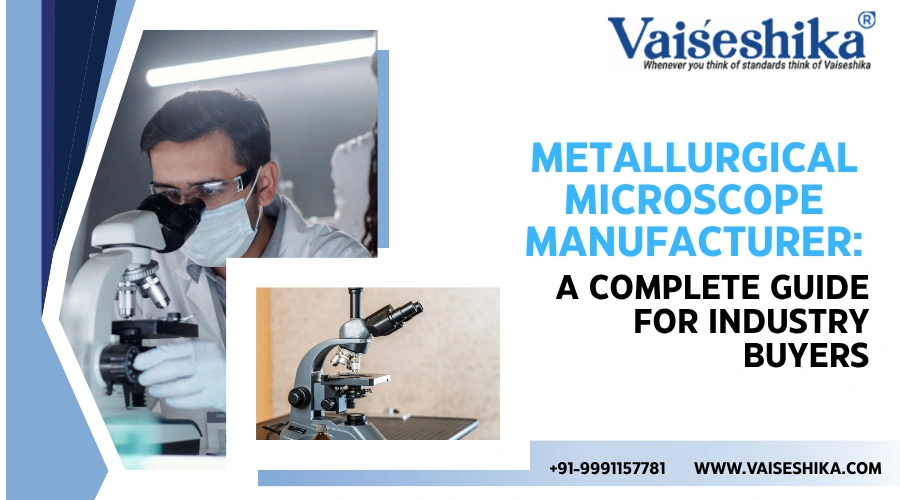
Precision inspection tools are necessary in industries whose performance and safety depend on the quality of materials. A metallurgical microscope is also very important in the examination of the microstructure of metals and alloys; it assists in ensuring that manufacturers are taking the correct direction in regard to quality and enhancing the reliability of their products. The selection of the appropriate Metallurgical Microscope Manufacturer is thus a major decision to be made by the laboratories, research and industrial units.
What is a Metallurgical Microscope?
A metallurgical microscope is a special optical device that is used to investigate the surface structure of metals and opaque materials. It has the advantage over biological microscopes of being able to use reflected light rather than transmitted light, and is thus applicable to solid, non-transparent samples, like steel, aluminum, and other alloys.
These microscopes have found wide application in industries such as automotive, aerospace, construction, and metallurgy labs to identify defects, examine grain structure, and verify that international quality standards are met.
Reasons why it is important to select the appropriate manufacturer
The choice of a good manufacturer of metallurgical microscopes will directly influence the quality and efficiency of your analysis. An excellent microscope guarantees:
- Clear imaging and resolution.
- Long-term use in industry.
- International standards.
- Coherent application performance.
Well-skilled manufacturers tend to invest more in research and development, which leads to sophisticated optical systems and ergonomic designs that will help in the user experience.
Main characteristics to consider
In comparing various manufacturers, the features of their metallurgical microscopes should be considered. The following are some of the crucial factors to be considered:
1. Optical Quality
The optics of a microscope is its heart. Lenses of high quality with high resolution and contrast enable users to see fine microstructures.
2. Illumination System
Illumination of reflected light plays an important role in metallurgical analysis. The high-end microscopes have adjustable LED or halogen light systems to gain better control and visibility.
3. Magnification Range
An adequate metallurgical microscope offers a high level of magnification to examine the macro and micro-level structures.
4. Mechanical Stability
The strong construction allows vibration-free operations, which is necessary to make precise observations in the industry.
5. Digital Integration
Contemporary microscopes are frequently accompanied by camera support and software integration to allow capturing of images, analyzing and reporting.
Applications Across Industries
Metallurgical microscopes play an essential role in many industries:
- Quality Control: Cracks, inclusions, and structural defects of metals can be detected.
- Research and Development: Investigating the properties of the materials and enhancing alloy compositions.
- Failure Analysis: Determining the reasons behind material failure in engineering parts.
- Education: Instruction of material science at universities and technical schools.
They are indispensable to any organisation that deals with metals and materials science due to their versatility.
Advantages of Collaboration with a Reliable Supplier
Several benefits are associated with the cooperation with an already existing Metallurgical Microscope Manufacturer:
- Technical Support: Installation, calibration and maintenance assistance.
- Customisation Options: Adaptations to industry needs.
- After-Sales Service: good service and availability of spares.
- Training: Advice on how to use and handle to achieve the best performance.
These will assist in a more efficient workflow and increase returns.
Trends in Metallurgical Microscopy
Metallurgical microscopy is a science that is changing with the development of technology. The new trends include:
- Digital Microscopy: Software integration to provide real-time analysis and reporting.
- Automation: Automated stage movement and focus to provide quicker inspections.
- AI-Based Analysis: Artificial intelligence to detect patterns and defects.
- High-Resolution Imaging: Improved optics to visualise microstructures in depth.
Companies that are implementing these innovations are establishing new standards in the industry.
Conclusion
Selection of a proper Metallurgical Microscope Manufacturer is very critical in ensuring proper analysis of the materials and quality of the product. With a concentration on optical performance, longevity, and technical innovation, companies could invest in equipment that would provide them with consistent performance.
To organizations that want accuracy, innovation and reliability in their operations, collaborating with a well-known name such as Vaiseshika can go a long way in ensuring they have reliable and quality metallurgical analysis.