



In precision measurement and calibration, accuracy is not merely desirable — it is non-negotiable. Industries ranging from aerospace and pharmaceuticals to power generation and food processing depend on temperature measurement systems that perform flawlessly under demanding conditions. At the heart of calibrating these systems lies a deceptively simple yet critically important instrument: the Decade Box for RTD Calibration. This guide explores what this instrument is, how it works, why it matters, and how it connects to the broader family of decade resistance and capacitance standards used in modern calibration laboratories.
Understanding RTDs and Why Calibration Is Essential
A Resistance Temperature Detector (RTD) is a temperature sensor that measures temperature by correlating the resistance of a pure metal element — typically platinum (Pt100 or Pt1000) — to a specific temperature value. As temperature rises, the electrical resistance of the metal increases in a predictable, highly repeatable manner. This property makes RTDs among the most accurate and stable temperature sensors available.
However, like all precision instruments, RTDs must be periodically calibrated to ensure they continue to deliver readings within acceptable tolerances. Over time, mechanical stress, contamination, thermal cycling, and aging can cause drift in an RTD’s resistance-temperature relationship. If left unchecked, this drift can lead to measurement errors that compromise product quality, process safety, and regulatory compliance.
Calibration involves comparing the output of the RTD under test against a known reference standard and correcting any deviation. This is precisely where the Decade Box for RTD Calibration becomes an indispensable tool.
What Is a Decade Box for RTD Calibration?
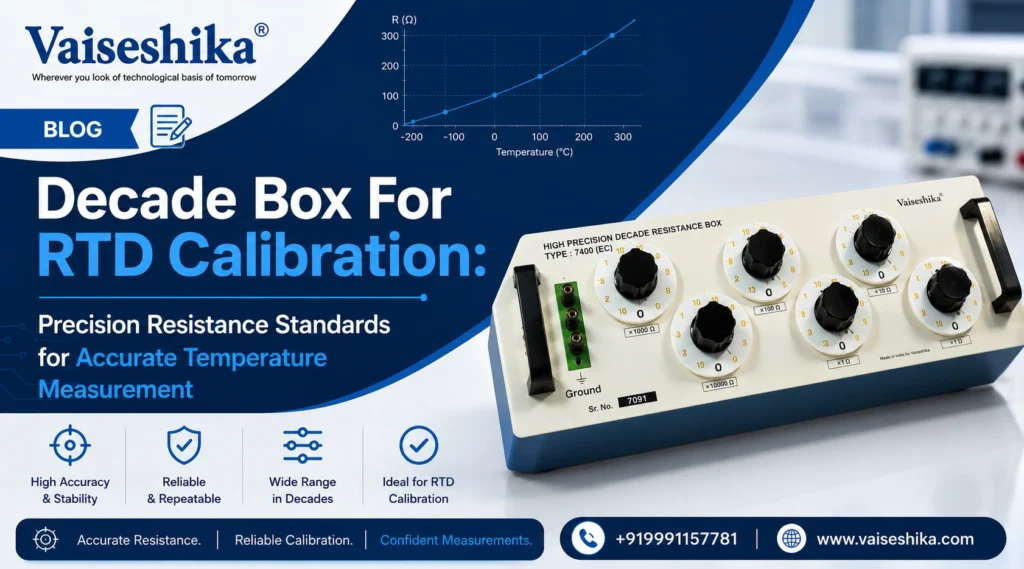
A Decade Box for RTD Calibration — more formally known as a Decade Resistance Box — is a precision instrument that allows the user to dial in highly specific and accurate resistance values across a defined range. The term “decade” refers to the arrangement of selectable resistance values in powers of ten (decades), enabling fine incremental adjustment from fractions of an ohm up to tens of thousands of ohms, depending on the model.
In the context of RTD calibration, a Decade Resistance Box simulates the resistance output of an RTD at various temperatures. By dialing in the exact resistance value that an RTD should produce at a given temperature, a calibration technician can verify — or adjust — the readout of a temperature transmitter, data logger, or process controller without needing to physically subject the sensor to that temperature. This is known as “simulation calibration” and is a widely accepted method in industrial metrology.
For example, a standard Pt100 RTD has a resistance of 100 Ω at 0°C and approximately 138.5 Ω at 100°C. By setting a Decade Box for RTD Calibration to these precise values and connecting it to the input of a temperature instrument, the technician can confirm that the instrument correctly displays 0°C and 100°C — without a temperature bath or furnace.
Key Features of a Professional Decade Resistance Box
Not all resistance decade boxes are created equal. When selecting a Decade Resistance Box for RTD calibration in a professional laboratory or industrial environment, the following features are essential:
Accuracy and Resolution
High-quality decade boxes offer resistance accuracy of ±0.01% or better, with resolution steps as fine as 0.001 Ω. This level of precision is mandatory when simulating Pt100 or Pt1000 RTD values, where even a 0.1 Ω error can correspond to a temperature error of approximately 0.25°C.
Low Temperature Coefficient
The resistance elements inside a calibration-grade decade box must have a very low temperature coefficient of resistance (TCR) — typically less than 5 ppm/°C. This ensures that the box’s own resistance remains stable across the ambient temperature range of the laboratory.
Multi-Decade Configuration
A well-designed Decade Box for RTD Calibration provides multiple switchable decades — for instance, units, tens, hundreds, and thousands of ohms — allowing the user to cover the full resistance range of common RTDs in a single instrument.
Low Contact Resistance
Rotary switches and terminal contacts in a decade resistance box must exhibit minimal and consistent contact resistance. Poor contact quality introduces uncertainty into calibration readings, defeating the purpose of using a precision standard.
Robust Construction
Laboratory instruments must withstand years of regular use. Precision-machined enclosures, high-quality rotary switches, and durable binding post terminals are hallmarks of a long-lasting, reliable decade resistance box.
Decade Box Capacitance: Expanding the Calibration Toolkit
While resistance simulation is the cornerstone of RTD calibration, modern calibration laboratories often require the ability to simulate not just resistance but also capacitance and inductance values. This is where Decade Box Capacitance instruments come into play.
A Decade Box Capacitance unit functions on the same principle as a decade resistance box — it allows the user to dial in precise capacitance values in stepped decades. These instruments are used to calibrate LCR meters, impedance analyzers, capacitance bridges, and other instruments that measure capacitive quantities.
In a comprehensive calibration setup, a laboratory may employ both a Decade Resistance Box for RTD and thermocouple simulation and a Decade Box Capacitance standard for electrical component testing and sensor calibration. Together, these instruments form the backbone of a versatile, traceable calibration system capable of addressing a wide range of measurement parameters.
Industries that benefit from decade capacitance boxes include electronics manufacturing, defence electronics testing, power systems engineering, and academic research in electrical metrology.
Applications of Decade Boxes for RTD Calibration Across Industries
The Decade Box for RTD Calibration is an essential tool in multiple sectors where temperature measurement accuracy is critical:
Pharmaceutical and Biomedical Manufacturing
FDA and GMP regulations require precise temperature monitoring in cleanrooms, autoclaves, cold storage, and process reactors. RTD calibration using decade resistance boxes ensures that temperature records are accurate and audit-ready.
Power Generation and Utilities
Turbines, boilers, and heat exchangers in power plants operate within tight temperature windows. Drift in RTD readings can lead to inefficiency or equipment damage. Regular calibration with a Decade Resistance Box maintains operational safety and efficiency.
Food and Beverage Processing
Pasteurization, fermentation, and cold chain management all depend on precise temperature control. Calibrating RTDs with a decade box confirms that process temperatures meet food safety standards consistently.
Aerospace and Defence
Thermal management in aircraft systems, propulsion testing, and environmental simulation chambers requires RTD calibration at extreme temperature ranges. Precision decade resistance boxes provide the simulation accuracy these demanding applications require.
Calibration Laboratories (NMI and NABL-Accredited)
National Metrology Institutes and accredited calibration labs routinely use decade resistance boxes as transfer standards and working standards for disseminating RTD calibration services to industry clients.
Academic and Research Institutions
Universities and research centers conducting experiments in thermodynamics, materials science, and cryogenics rely on decade resistance boxes to simulate and verify RTD behaviour under controlled experimental conditions.
How to Use a Decade Box for RTD Calibration: Step-by-Step
Using a Decade Box for RTD Calibration is straightforward when following a structured procedure:
- Identify the RTD type — Determine whether you are simulating a Pt100, Pt1000, Ni100, or other RTD type. Each has its own resistance-temperature table.
- Select the target temperature points — Choose the temperature points at which the instrument under calibration will be verified, such as 0°C, 50°C, 100°C, 150°C, and 200°C.
- Calculate the corresponding resistance values — Use the standard resistance-temperature table (IEC 60751 for platinum RTDs) to identify the exact resistance for each temperature point.
- Set the Decade Resistance Box — Dial in the required resistance value on the decade box with the appropriate precision.
- Connect the decade box to the RTD input terminals of the instrument under calibration, using a 2-wire, 3-wire, or 4-wire connection as required by the instrument.
- Record the instrument’s displayed temperature and compare it to the expected value. Note any deviation.
- Document and report — Record all findings in the calibration report, noting uncertainties, pass/fail results, and any adjustments made.
Why Vaiseshika Decade Boxes Are the Preferred Choice for RTD Calibration
When it comes to precision resistance and capacitance decade boxes, Vaiseshika has been the benchmark of quality in India and across global markets for over 50 years. As a leading manufacturer of calibration standards and optical instruments since 1976, Vaiseshika produces a comprehensive range of Decade Box for RTD Calibration instruments, Decade Resistance Boxes, and Decade Box Capacitance standards — all engineered to the highest metrological specifications and compliant with ISO 9001 and ISO 17025:2017 quality frameworks. Vaiseshika’s decade boxes are trusted by NABL-accredited calibration laboratories, defence organizations, research institutions, space agencies, and industrial giants across Asia, Europe, the Middle East, and Africa. Every instrument is built for long-term reliability, with a guaranteed maintainability period of 10 to 15 years and comprehensive after-sales support. Whether you require a high-precision Decade Resistance Box for RTD simulation, a multi-range Decade Box Capacitance standard, or a custom-configured calibration solution, Vaiseshika delivers world-class accuracy — Made in India, Built to Global Standards. Explore the full range of Vaiseshika calibration standards at www.vaiseshika.com and take the next step toward measurement confidence.
Frequently Asked Questions (FAQs)
Q1. What is a Decade Box for RTD Calibration and how does it work?
A Decade Box for RTD Calibration is a precision instrument that allows technicians to simulate the exact resistance output of an RTD (Resistance Temperature Detector) at specific temperature points. By dialing in a known, accurate resistance value, the technician can verify whether a connected temperature instrument — such as a transmitter or data logger — correctly interprets that resistance as the corresponding temperature. This method of simulation calibration eliminates the need for physical temperature baths at every calibration point, making the process faster and more flexible.
Q2. What is the difference between a Decade Resistance Box and a Decade Box for RTD Calibration?
A Decade Resistance Box is the general instrument category — it is a switchable precision resistance standard used in a wide variety of electrical and electronic calibration applications. A Decade Box specifically used for RTD Calibration is a Decade Resistance Box selected or configured with the accuracy, resolution, and resistance range appropriate for simulating RTD sensors (typically 0–400 Ω for Pt100 RTDs, or 0–4000 Ω for Pt1000 RTDs). In essence, all RTD calibration decade boxes are decade resistance boxes, but not all decade resistance boxes are optimized for RTD calibration.
Q3. What is a Decade Box Capacitance and where is it used?
A Decade Box Capacitance is a precision instrument that provides selectable, switchable capacitance values in decade steps. It is used to calibrate and verify LCR meters, impedance analyzers, capacitance bridges, and electronic test equipment that measure capacitive quantities. Industries such as electronics manufacturing, power systems, telecommunications, and defence use decade capacitance boxes to maintain the accuracy of their capacitance measurement instruments in accordance with traceability requirements.
Q4. How accurate does a Decade Resistance Box need to be for RTD calibration?
For professional RTD calibration, the Decade Resistance Box should offer an accuracy of at least ±0.01% of the set resistance value, with resolution steps of 0.01 Ω or finer. For calibrating Pt100 RTDs — where 0.39 Ω corresponds to approximately 1°C — a resistance error of even 0.1 Ω can introduce a temperature uncertainty of about 0.25°C. For high-precision calibrations traceable to national standards, accuracy of ±0.005% or better may be required.
Q5. How often should a Decade Box for RTD Calibration be recalibrated?
Like all precision measurement standards, a Decade Box for RTD Calibration should be recalibrated at regular intervals — typically every 12 months for instruments used in accredited calibration laboratories, or as specified by the laboratory’s quality management system. The recalibration interval may be adjusted based on usage frequency, environmental conditions, and the stability history of the specific instrument. Recalibration should be performed by an accredited laboratory with traceability to national or international measurement standards such as those maintained by NPL India or BIPM.