



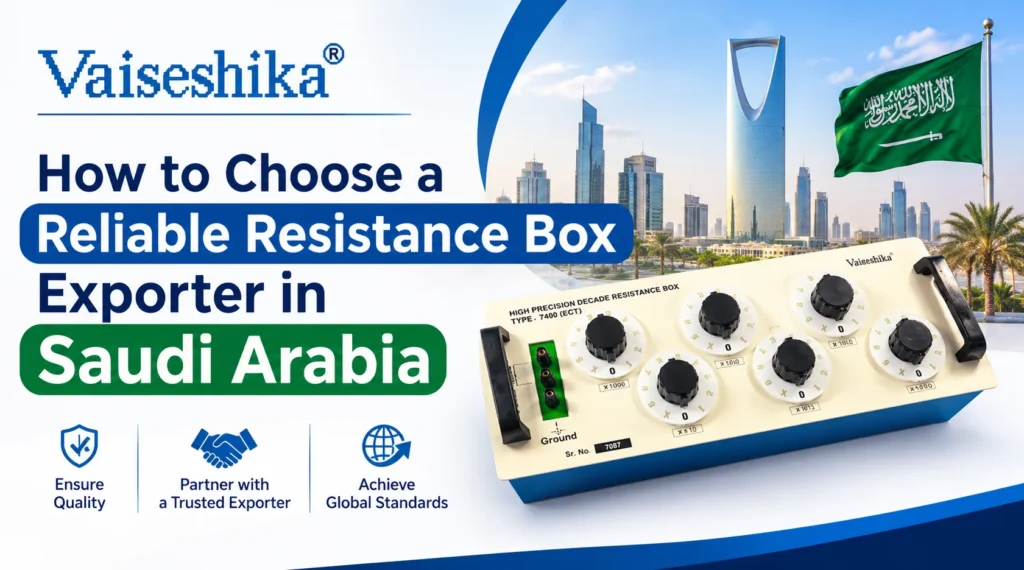
Walk into any electrical lab, calibration center, or training institute in Saudi Arabia and you will likely find a resistance box on the bench. It is a small instrument, but when it fails or drifts out of accuracy, test results suffer and projects stall.
As the Kingdom expands its industrial, energy, and education sectors, demand for precise testing equipment keeps growing. That makes choosing the right resistance box exporter in Saudi Arabia an important decision. This guide covers what a resistance box does, where it is used, and what to check before you buy.
What Is a Resistance Box?
A resistance box is a device holding a set of precision resistors that can be switched in or out of a circuit to give a known resistance value. Instead of swapping individual resistors, the user turns a dial or moves a plug to select the needed value.
Many people know it from school physics practicals, where it is used with a Wheatstone bridge or metre bridge. In industry, it plays a much bigger role in calibration, simulation, and troubleshooting.
Common Types of Resistance Boxes
- Plug-type resistance box: Uses removable brass plugs to bypass resistors. Popular in educational labs because the working principle is easy to see.
- Decade resistance box: Uses rotary switches for each decade (ones, tens, hundreds, and so on). It offers fine, fast adjustment and is common in professional labs.
- Precision resistance box: Built with low-tolerance, low-temperature-coefficient resistors for calibration work.
- High-power resistance box: Designed to handle higher current and dissipate heat, often used in industrial load testing.
Where Resistance Box Exporter in Saudi Arabia
The Kingdom’s economic diversification has pushed investment into manufacturing, utilities, renewable energy, and technical education. Resistance boxes serve all of these areas.
- Universities and technical colleges: Physics and electrical engineering practicals in cities such as Riyadh, Jeddah, and Dammam.
- Calibration and testing laboratories: Verifying meters, sensors, and measuring instruments.
- Power and utilities: Simulating loads and testing protection relays.
- Oil, gas, and petrochemical facilities: Simulating RTD and thermocouple signals during instrument checks.
- Electronics manufacturing and R&D: Prototype testing and circuit design.
- Vocational training centers: Hands-on practice for apprentices and technicians.
Why Work With a Specialized Exporter?
You can buy general lab equipment from many places, but a dedicated exporter usually offers advantages that matter on bigger or repeat orders:
- Consistent quality control: Instruments are tested before dispatch, not just packed and shipped.
- Bulk and custom supply: Institutions often need dozens of identical units, or custom resistance ranges.
- Export documentation: Experienced exporters know how to prepare invoices, packing lists, and certificates of origin correctly.
- Better pricing at scale: Direct supply removes unnecessary middlemen.
- After-sales support: If a unit arrives damaged or a value is off, you have someone accountable to talk to.
If you are comparing suppliers, it is worth reviewing the range of laboratory and scientific instruments offered by exporters such as Vaiseshika to see what specifications and product categories are available.
Key Factors to Check Before You Buy
1. Resistance Range and Step Size
Decide what range you need, for example 1 Ω to 10 kΩ or higher, and how fine the steps must be. A teaching lab and a calibration lab have very different needs.
2. Accuracy and Tolerance
Resistor tolerance may be 1%, 0.1%, or tighter. Higher accuracy costs more, so match the tolerance to the job instead of overpaying.
3. Power Rating
Every resistor has a maximum power it can handle. Running a box beyond its rating causes heating, drift, and eventually damage.
4. Build Quality and Materials
Look for solid terminals, good contact points, clean switch action, and a durable enclosure. Saudi Arabia’s heat and dust can be hard on cheap components, so rugged construction matters.
5. Calibration Certificate
For professional and industrial use, ask whether a calibration certificate traceable to recognized standards is available.
6. Packaging for Long-Distance Shipping
Delicate switches and resistors need protective foam, sturdy cartons, and moisture protection. Poor packaging is a common cause of transit damage.
Understanding Export and Import Requirements
Shipping instruments to the Kingdom involves paperwork, and delays usually come from missing or incorrect documents. Be ready to discuss these points with your supplier:
- Commercial invoice and packing list with accurate HS codes and product descriptions.
- Product conformity requirements. Saudi Arabia uses the SABER platform for many product categories, so confirm with your supplier and customs broker whether your instrument needs a certificate.
- Certificate of origin, often requested for customs clearance.
- Shipping method and port: Common entry points include Jeddah Islamic Port, King Abdulaziz Port in Dammam, and major air cargo hubs in Riyadh and Jeddah.
- Incoterms: Clarify whether the price is EXW, FOB, CIF, or DDP so there are no surprises on freight and duties.
Regulations change from time to time, so always verify current rules with Saudi customs authorities or your clearing agent before placing an order for Resistance Box Exporter in Saudi Arabia.
Practical Tips for Importers and Institutions
- Request a sample or datasheet before committing to a large order.
- Ask for photos or a short video of the actual stock being shipped.
- Compare total landed cost, not just the unit price. Freight, duties, and clearance fees add up.
- Confirm the warranty period and how replacements are handled.
- Keep a maintenance routine: clean contacts occasionally, avoid overloading, and recalibrate on schedule.
- Store units in a dry, dust-free place when not in use.
Mistakes to Avoid
- Choosing purely on the lowest price, which often means looser tolerances and weaker construction.
- Ignoring the power rating for high-current applications.
- Skipping documentation checks until the shipment is already at the port.
- Failing to specify the required resistance range clearly in the purchase order.
Conclusion
A resistance box may look simple, but accurate measurement depends on it. Whether you run a university lab in Riyadh, a calibration facility in Jubail, or a training center in Jeddah, the supplier you choose affects quality, delivery time, and long-term reliability.
The best approach is to define your technical needs first, then compare exporters on accuracy, build quality, documentation support, and after-sales service. Do that, and finding a dependable resistance box exporter in Saudi Arabia becomes far easier. To explore available instruments and request specifications, visit Vaiseshika.
Frequently Asked Questions (FAQs)
1. What is a resistance box used for?
A resistance box provides adjustable, known resistance values in a circuit. It is used for physics experiments, instrument calibration, signal simulation, and electrical testing.
2. What is the difference between a plug-type and a decade resistance box?
A plug-type box uses removable plugs to select resistance, which suits teaching. A decade box uses rotary switches, which allows faster, finer adjustment and suits professional work.
3. How do I choose a reliable resistance box exporter in Saudi Arabia?
Check product accuracy, build quality, available certificates, export documentation support, packaging standards, and after-sales service. Asking for samples or datasheets helps you compare suppliers fairly.
4. Do I need special documents to Resistance Box Exporter in Saudi Arabia?
You typically need a commercial invoice, packing list, and certificate of origin. Depending on the product category, conformity certification may also apply. Confirm current requirements with your customs broker.
5. How often should a resistance box be calibrated?
It depends on usage and accuracy needs. Many labs recalibrate once a year, while heavily used or high-precision units may need more frequent checks.